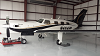
I took a demo flight in a brand new 2017 Cirrus SR22T GTS G6 yesterday. The short version is "wow".
Granted, it's probably easy to impress me as I haven't flown any modern aircraft, except for one time with G2 SR22 a few years ago, but it was as a passenger, so I've got to feel the controls only briefly in cruise. I also flown Cessna 172SP with G1000 when it just came out, but it felt just like any other Cessna out there, just with some fancy avionics. The rest of my experience was in vintage Cessnas, Pipers and Beeches.
So, back to SR22.
I like the doors. Besides that they are on both sides, the gas struts that hold door open do a pretty good job on windy days, so you don't have to worry that it will either break the locking mechanism or suddenly hit you when there is a gust.
Getting into the pilot seat is fairly easy, but I haven't had any problems doing that in my Bonanza as well.
The seats are pretty comfortable, and I like 4-point harnesses with the airbags. Everything is within reach, I don't have to lean forward in order to switch tanks or manipulate avionics or do anything else in the airplane. The only exception is probably the AC controls, but it's not that hard to reach them either. Oh, actually, there is one thing that is not conveniently placed, and that's a cup holder.

It's located under your left foot, similar to where the fuel selector is placed in my Bonanza.
I also like the fact you don't need control locks, thanks to the spring-loaded side yoke. I liked the yoke and throttle placement. You can sit in a very relaxed position with your hands on the controls.
The forward visibility is worse compared to Bonanza with its panoramic views due to Cirrus's thick door frame. Not an issue, really, but I think Bonanza wins here.
Starting the engine was very simple, and it was a hot start. It started right away following normal startup procedure without excessive RPM or anything like that. In my Bonanza it's always a challenge to get it to start when hot. The only way to do it reliably in my Bo (after running a fuel pump to get rid of vapor lock) is to move the throttle full forward when cranking and then promptly retard it to normal RPM when it starts. I've tried all the techniques posted on Beechtalk and this is the only one that works reliably for me, but YMMV of course.
It was getting hot inside with the doors closed… and then we turned on the A/C. I want A/C in my next airplane!!! What's better, you don't have to turn it off for any phase of flight, even takeoff!
The next was taxiing. I was surprised how stable Cirrus is on the ground. I expected quite a dance on the brake pedals to keep it straight, but it was even easier than in my Bonanza. The required brake pressures for steering are very minor and I got used to it very quickly. I liked the turn radius, this thing just turns on a dime!
I liked having the checklist on MFD, however I think if they added a side button on the yoke to advance the checklist, it would be even more usable, especially in flight.
During the flight controls check I noticed that the yoke doesn't have much travel in either direction, and has a weird feel to it because of the spring cartridge.
I expected a lot of right rudder on takeoff given that the nosewheel is not directly steerable and you don't want to use brakes at that moment, but it was also a non-event, and the amount of required rudder pressure was similar or even less than my Bonanza. Or at least it felt that way. But I advanced the throttle slowly, probably around 4-5 seconds to full power. The throttle was very stiff, but probably just need to adjust the friction lock..
At 77 knots I gently pulled on the yoke (applied the pressure really) and it rotated with a healthy rate of climb right away. It accelerated really fast to and beyond Vy. Very unusual feeling after my Bonanza, because I see a similar rate of climb only after I raise the gear…
The automatic yaw dampener activated around 200 AGL, so I didn't have to apply any right rudder anymore. Weird, but convenient. We set up the autopilot to maintain heading and the IAS to the target altitude - it is called Flight Level Change (FLC) in the new Perspective+ system (it was IAS mode in the previous versions). I have a crappy 1-axis Century IIB autopilot in my Bonanza, so I was really impressed with the digital autopilot in Cirrus. It was quite bumpy with some updrafts and downdrafts, but autopilot handled it quite well.
The new Perspective+ (based on G1000 NXi) is a noticeable improvement over the older G1000. Not that I have a lot of experience with either, but you immediately notice how much smoother the Nxi is.
Even the displayed traffic has smooth, continuously updated movement as opposed to jerky 1fps movement in all other systems. Of course, the traffic updates still come with 1Hz frequency or less, but system just interpolates the position so it is smooth on the screen. The effect is very cool!
Leaning was as simple as it gets - set the cruise power and pull back the fuel flow to the blue line on the gauge, and you are running LOP! We didn't climb too high, but I've seen 170 KTAS at 5500 at 16.8 gph LOP with the power setting at around 78%. I can do better in my Bonanza down low at the same fuel flow, but I believe NA version would be closer in terms of fuel burn?
Then there was a hand-flying part. I'd say, I like the feel of the side yoke, and the transition was very quick and natural. I even like the trim mechanism using spring cartridge. The downside is that if your electric trim craps out, you have no other way to adjust trim. On the other hand, it's much easier to handle out of trim airplane, since you don't have to fight aerodynamic forces of the trim tab, just the springs. The airplane is very responsive to both pitch and trim, so you just apply light control pressures. The biggest challenge for me was the throttle. I completely forgot about friction adjustment, so probably it would be different experience, but the way it was set up was too stiff. Very hard to make minor adjustments. Or maybe I'm just spoiled by vernier throttle in my Bonanza…
We shot the approach back to RHV on autopilot. Very easy to load an approach, and activating vectors to final doesn't remove all waypoints from the flight plan, but I guess it was fixed in 650/750 as well. I like that the radio frequencies are labeled in the COM windows. If I have RHV tower frequency dialed in, either automatically or manually, it labels it as KRHV tower, so you know that you are at the correct frequency.
You can deploy the first notch of flaps at 150 knots indicated in G6 Cirrus, and they act as a nice speed brake - very easy to slow the plane down to normal approach speeds.
I turned off the autopilot about 3 miles out, deployed full flaps on final and trimmed to 80 knots, just like in Bonanza. I like how flaps handle is positioned - you don't have to lift your hand - a quick flick with your fingers and the flaps are down.
At 200 ft AGL the yaw damper disengaged, and I handed controls over to Cirrus rep. I was established on final and could land it, but I was slightly worried about my relationship with the throttle, being unable to make smooth and small power changes, and felt just a tad behind the airplane, overwhelmed by all the gadgets, so with a gusty winds I decided just to follow through on the yoke and pedals to get a feel of what normal Cirrus landing looks like.
The sight picture is a little bit different, but otherwise looks easy enough. With the proper approach speed and slowly pulling the throttle back to idle just when you are about to flare, it doesn't float much. The brakes are excellent too.
Overall, it was wonderful experience, thanks to local Sales Director at Cirrus.
I'm not in the market for a brand new airplane, at least in the next 2-3 years, but Cirrus would be my #1 choice for single-engine piston airplane.
Now I need to refresh my memory and test drive an older Cirrus to see how they are different and if I enjoy it as much as I enjoyed G6 version.














 Even if I had that kind of money to burn on a personal airplane this Cirrus would be close to last on my list. I know - I'm old school - but there are so many choices at that price point. Technically advanced and well made they are. Aesthetically they bore me. Ferrari of the skies they are not.